




India’s Role in Emerging World Order Discussed at The Club’s 162nd Virtual Meeting
Prof. Dr Surya Narayan Mishra analyses changing global power equations, technology, BRICS and India’s diplomatic role
Bhubaneswar: The Club organised its 162nd virtual meeting in its sixth year, in association with Kalinga IAS Academy, Bhubaneswar, bringing together aspiring civil service candidates, intellectuals and senior participants for a discussion on “India in the Emerging World Order.”
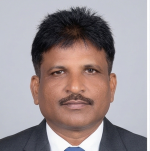
Professor Dr Surya Narayan Mishra, former Professor of Political Science at Utkal University, was the chief speaker. In his address, Prof. Mishra traced the evolution of the international political system from 1648 and examined the major transformations in the global order following the two World Wars.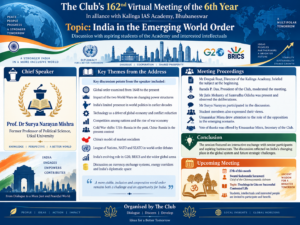
He observed that although India has historically possessed a rich cultural and civilisational heritage, its influence in international power politics remained limited for long periods. Referring to developments after Independence, he reviewed the country’s foreign-policy journey and the challenges India faced in establishing itself as an influential global power.
Prof. Mishra said that the present international system is increasingly driven by technology, innovation and economic competitiveness. Faster adoption of emerging technologies, he argued, could accelerate economic growth and also contribute to better international cooperation.
At the same time, he expressed concern over increasing competition among major powers. According to him, conflicts and geopolitical tensions have contributed to the growth of what he described as a “war economy”, with the international arms trade benefiting from continuing instability.
Tracing earlier global rivalries, Prof. Mishra discussed the Cold War between the Soviet Union and the Western bloc led by the United States and examined how strategic equations have continued to change in the post-Cold War era. He also referred to China’s economic system and its combination of state-led political structures with market-oriented economic policies.
The former Utkal University professor also discussed the failure of the League of Nations and the emergence of military groupings such as NATO and SEATO as part of the changing international security architecture.
Turning to India, Prof. Mishra reviewed important episodes in the country’s diplomatic and security history. He referred to developments relating to Kashmir and the 1962 India-China war, arguing that these events should be studied by future administrators to understand the relationship between diplomacy, defence preparedness and national strategy.
A major part of his address focused on India’s more recent diplomatic initiatives. Prof. Mishra said the government led by Prime Minister Narendra Modi had sought to expand India’s presence in international forums while maintaining relations with different centres of global power. He described this approach as being “not anti-West, but non-West”, highlighting India’s attempt to retain strategic autonomy while engaging with different blocs.
The discussion also examined India’s role in the G20 and BRICS.
India held the BRICS chairship for the fourth time in 2026 and hosted the 18th BRICS Summit in New Delhi on September 12–13, 2026. The expanded grouping currently has 11 full members—Brazil, Russia, India, China, South Africa, Egypt, Ethiopia, Indonesia, Iran, Saudi Arabia and the United Arab Emirates.
Prof. Mishra viewed the 2026 summit as an important moment for India’s engagement with the Global South and for discussions on a more multipolar international order. He also referred to debates over trade in local currencies, alternative payment mechanisms, energy security and reforms of international institutions. The summit communiqué included initiatives aimed at promoting greater use of local currencies and strengthening the representation of emerging economies in global institutions.
He further discussed India’s long-standing aspiration for permanent membership of the United Nations Security Council. At present, the Council continues to have five permanent members—China, France, Russia, the United Kingdom and the United States—while India is not a permanent member.
Prof. Mishra said he remained optimistic about India’s future role in international affairs. Following his address, he interacted with senior participants and answered questions raised by civil service aspirants regarding changing geopolitical equations and India’s strategic choices.
Mr Deepak Rout, Director of Kalinga IAS Academy, introduced the subject at the beginning of the programme, while Barada P. Das, President of The Club, moderated the meeting.
Mr Jatis Mohanty of Samrudha Odisha attended the programme and closely followed the deliberations. Mr Surya Narayan participated in the discussion, while several students also expressed their views.
Umasankar Misra, Secretary of The Club, drew the chief speaker’s attention to the role of the opposition in the emerging political and strategic environment and later proposed the vote of thanks.
Concluding the programme, the President announced that the Club’s next meeting will be held on September 27, when Swami Sadananda Saraswati, Chief of the Chinmayananda Ashram, will speak on “Teachings in the Gita for a Successful and Contented Life.”
Students, intellectuals and other interested participants have been invited to join the session and benefit from the deliberations.