




Thinkers’ Club Pays Rich Tribute to Freedom Fighter and Statesman late Nityananda Kanungo
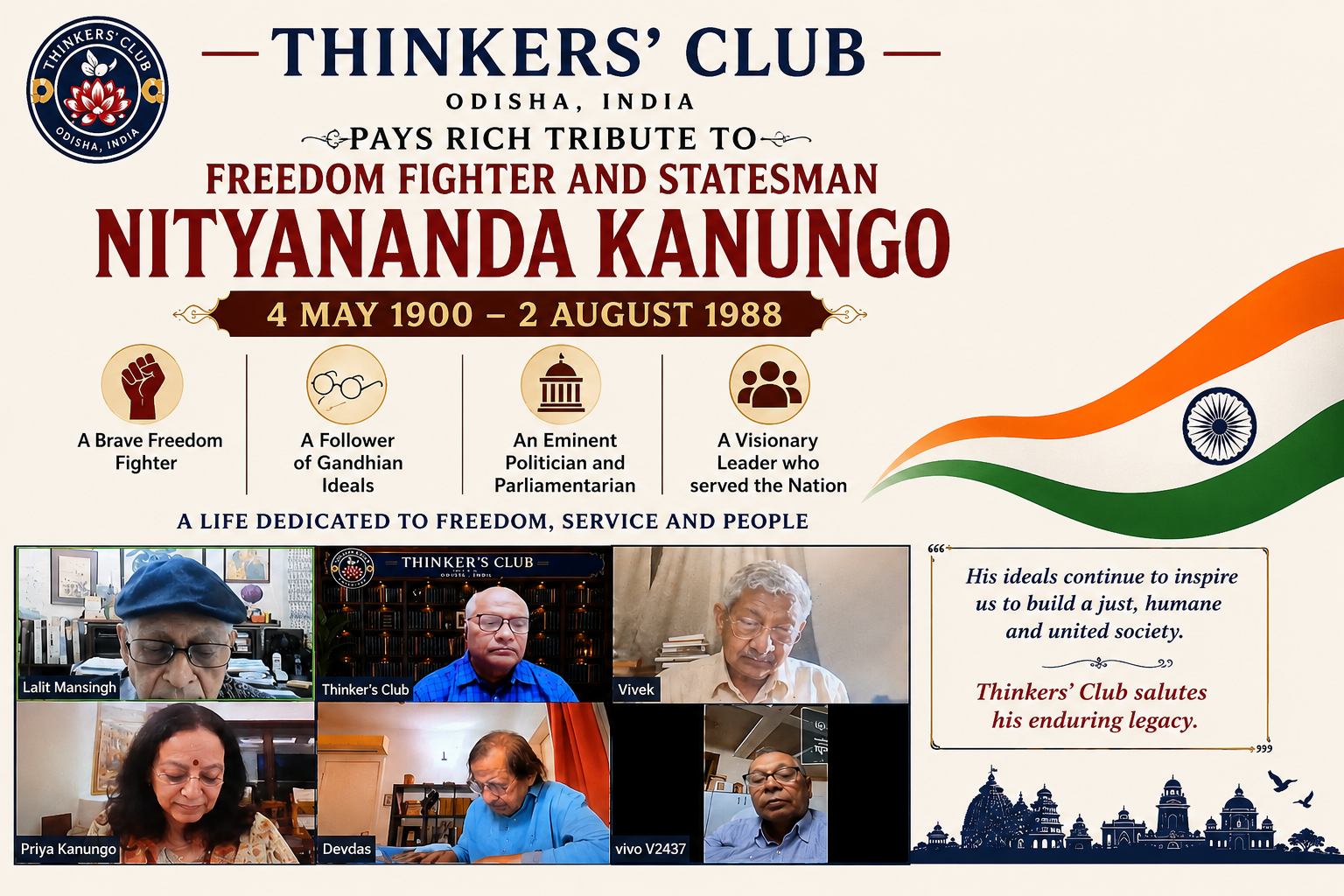
Bhubaneswar, August 3: The Thinkers’ Club, during its 158th webinar of the sixth year, organised a solemn tribute meeting in memory of late Nityananda Kanungo one of Odisha’s most distinguished freedom fighter, Gandhian leaders, parliamentarians and administrators. The online event, conducted through Zoom and streamed live on YouTube, brought together eminent diplomats, scholars, retired civil servants, intellectuals and social leaders to commemorate the life and legacy of the veteran leader.
The meeting was presided over by senior retired sr.
bureaucrat Vivek Pattanaik, while Advocate Barada Das, President of the Thinkers’ Club, moderated the proceedings. Distinguished speakers included Lalit Mansingh, former Ambassador and retired secy of central Foreign ministry and noted poet and former Vice-Chancellor of Ravenshaw University Devdas Chhotray, a retired IAS officer.
Opening the session, Barada Das recalled the remarkable journey of Nityananda Kanungo, describing him as an exceptional public servant whose life was dedicated to the ideals of Mahatma Gandhi and nation-building. He highlighted several lesser-known aspects of Kanungo’s personal and political life, tracing his rise from a respected family background to becoming one of independent India’s most accomplished leaders.
Kanungo, belonged to an affluent zamindar family. His father, Balmukund Kanungo,ex dy magistrate had adopted the renowned freedom fighter Sarala Devi as his daughter, reflecting the family’s deep commitment to social reforms and nationalism. Throughout his life, Kanungo remained devoted to the Gandhian philosophy of truth, simplicity and service.
Delivering the keynote address, Lalit Mansingh said Kanungo was inspired from an early age by the teachings of Swami Vivekananda and the writings of Bankim Chandra Chatterjee,swami chinmayanand Motivated by these ideals, he actively participated in Mahatma Gandhi’s freedom movement and joined the historic Salt Satyagraha. During the struggle for independence, he spent nearly seven years in Hazaribagh Jail, displaying unwavering commitment to the national cause.
Mansingh described Kanungo as a rare statesman whose concern always remained focused on the welfare of ordinary citizens. According to him, Kanungo believed that the true purpose of governance was to improve the quality of life of the common people. Whether serving in public office or interacting with citizens, he displayed remarkable humility, integrity and compassion. He noted that Kanungo discharged every responsibility entrusted to him with dignity, sincerity and complete dedication.
Kanungo’s public career was equally illustrious after Independence. He served as a minister in the first Odisha Cabinet under Biswanath Das and later under Harekrushna Mahatab. At the national level, he became a Union Minister in the cabinet of Jawaharlal Nehru, handling key portfolios including Commerce, Industry and Civil Aviation. Later, he served with distinction as the Governor of Gujarat and Bihar, earning respect for his administrative ability and constitutional propriety.
Speaking on Kanungo’s contribution beyond politics, Devdas Chhotray highlighted his deep interest in Odisha’s literature, art and cultural heritage. He observed that Kanungo played an important role in promoting the state’s cultural identity and extending support to several significant initiatives. Chhotray particularly referred to the Peace Pagoda at Dhauli, describing the Indo-Japanese monument as a lasting symbol of Kanungo’s contribution towards promoting peace, cultural understanding and international friendship.
In his presidential address, Vivek Pattanaik described Kanungo as a disciplined administrator and a visionary leader whose standards of public life remain relevant even today. He expressed concern that personalities of Kanungo’s stature have become increasingly rare in contemporary politics. Pattanaik regretted that the nation had not accorded him the recognition he truly deserved and proposed that one of the major roads in Cuttack be named after him. He recalled that Kanungo spent a significant part of his life at his residence in Bakharabad, Cuttack, making the city closely associated with his public career.
The webinar witnessed participation from a large number of academicians, professionals and public intellectuals. Among those present were Prof. Umasankar Misra, Dr. Nanda Nandan Das, Dr. Sarat Chandra Behera, Prof. Dr. Niranjan Barick, Dr. Nibedita Mohanty, Devadalan Rath, Ajit Sahi, Jaya Bhattacharjya, Aayans Giri, Jatin Kumar, Durgesh Nandini and Aakankhya, besides many others who joined through Zoom and YouTube.
The programme concluded with Priya Kanungo, granddaughter of the late leader, delivering the vote of thanks. Expressing gratitude to the speakers and participants, she acknowledged the efforts made to preserve and celebrate her grandfather’s enduring legacy.
At the end of the session, Advocate Barada Das announced that the 159th webinar of the Thinkers’ Club will be held on 9 August 2026 at 8:00 p.m. via Zoom. The next discussion will focus on the much-debated Uniform Civil Code, where leading experts are expected to deliberate on its constitutional, legal and social implications.